
Anolis distichus
—
Bark Anole
Subspecies I've seen:
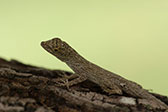
A. d. floridanus
Florida Bark Anole
Anolis distichus floridanus
—
Florida Bark Anole
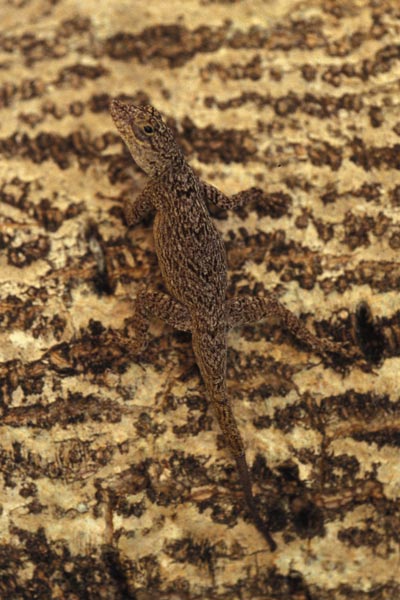
Bark anoles are another non-native species of anole in south Florida, although they've been around long enough (more than 50 years) that some authorities (including the SSAR) distinguish the ones in Florida as a distinct subspecies. They spend their time clinging to trunks and large branches of trees, and this picture shows that they've evolved a good camouflage for this lifestyle.
Todd Jackman has an excellent anole site that discusses the parallel forms and lifestyles that different sets of anoles have evolved on different Caribbean islands.
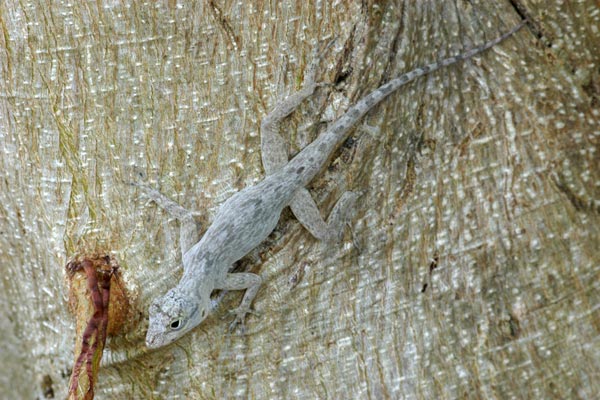
Here's another bark anole from South Florida deciding how much longer to wait before dashing out of sight. (The answer -- one more shutter snap.)
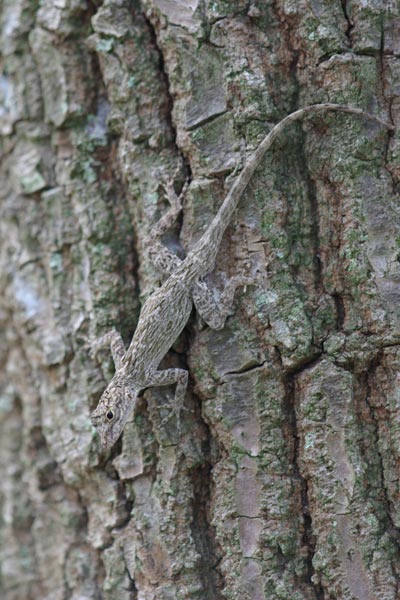
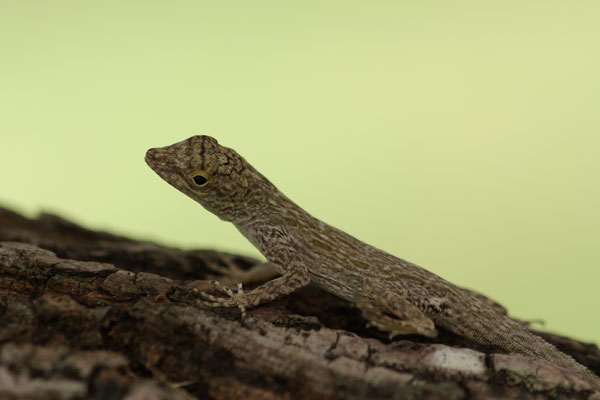
A couple of Christmas Day bark anoles showing off their camouflage, if such a thing is possible.
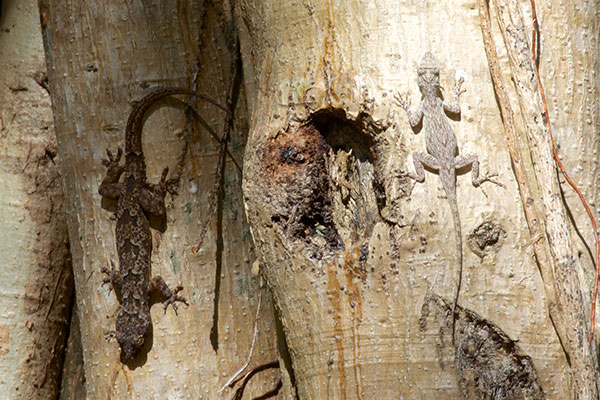
I like to think that this is the spot on the tree where the day shift workers check out and the night shift workers check in. In this case, the day shift worker (on the right) is the non-native Bark Anole, and the night shift worker (on the left) is the non-native Wood Slave (one of my favorite standard English herp names).
Printed references:
- Ashton, R. E. Jr., Ashton, P. S. 1991. Handbook of Reptiles and Amphibians of Florida, Part Two: Lizards, Turtles, & Crocodilians, Revised Second Edition
- Bartlett, R. D., Bartlett, P. B. 1999. A Field Guide to Florida Reptiles and Amphibians
- Behler, J. L., King, F. W. 1979. The Audubon Society Field Guide to North American Reptiles & Amphibians
- Carmichael, P., Williams, W. 1991. Florida's Fabulous Reptiles & Amphibians
- Conant, R., Collins, J. T. 1998. Peterson Field Guide to Reptiles and Amphibians of Eastern and Central North America, Third Edition, expanded
- Crother, B. I. (ed.) 2017. Scientific and Standard English Names of Amphibians and Reptiles of North America North of Mexico, with Comments Regarding Confidence in Our Understanding, Eighth Edition
- Henderson, R. W., Schwartz, A. 1984. A Guide to the Identification of the Amphibians and Reptiles of Hispaniola
- Rogner, M. 1997. Lizards
- Schwartz, A., Henderson, R. W. 1991. Amphibians and Reptiles of the West Indies: Descriptions, Distributions, and Natural History
- Smith, H. M., Brodie, E. D. Jr. 1982. Reptiles of North America: A Guide to Field Identification