
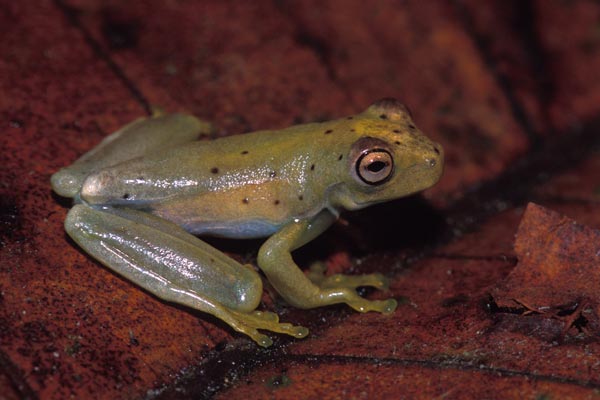
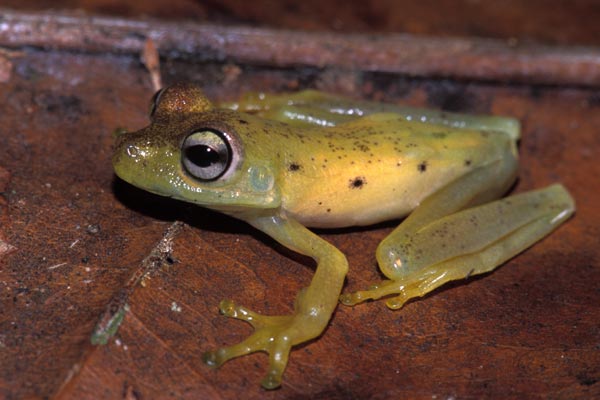
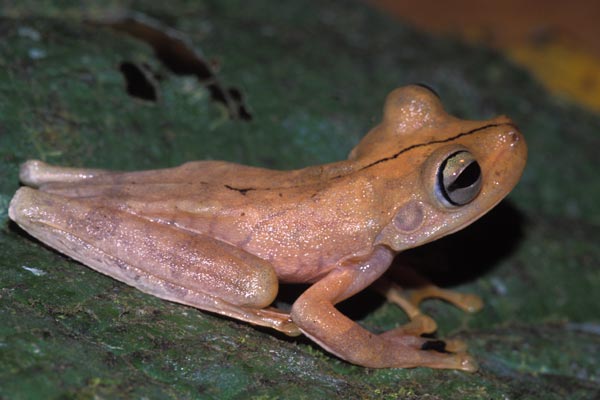
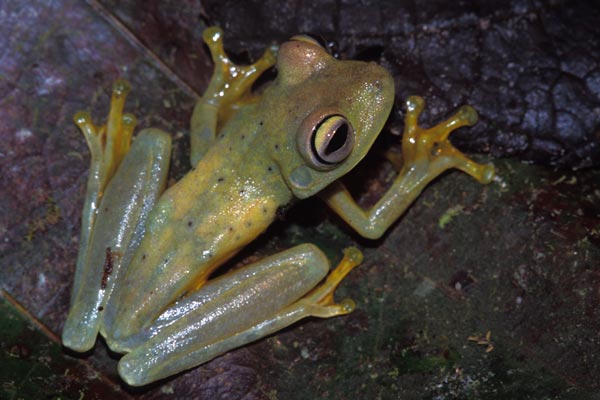
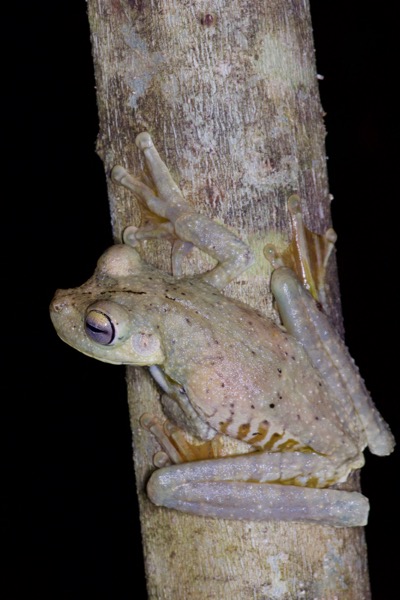
Simon Lailvaux of the Department of Ecology and Evolutionary Biology at Tulane University explained to me why they are called Gladiator frogs:
"the reason is that male H. rosenbergi frogs have a sharp bony spine on each hand that is used as a dagger in fights between males over females and nests. Many males are wounded in these fights, and some are even killed. This is probably due to the small size of the breeding ponds, and unusually strong predation pressure - these frogs seldom live longer than a year, so males that fail to defend a decent nest probably won't get another chance in the next season."
Biologist Gerlinde Hoebel wrote me to add more information about this behavior. The fighting behavior among male H. rosenbergi was recorded from a study in Panama. Hoebel's studies in Costa Rica showed no evidence of such behavior, possibly due to the abundance of desirable basins for egg-laying. So the common name of this frog seems to be an overgeneralization based on a behavior that does not occur everywhere in the frog's range.
These frogs were photographed on a herping trip with GreenTracks. Here is a complete list of the species we found on this GreenTracks trip.
- Beletsky, L. 1998. Costa Rica: The Ecotraveller's Wildlife Guide
- Duellman, W. E. 2001. Hylid Frogs of Middle America
- Leenders, T. 2001. A Guide to Amphibians and Reptiles of Costa Rica
- Obst, F. J., Richter, K., Jacob, U. 1988. The Completely Illustrated Atlas of Reptiles and Amphibians for the Terrarium
- Savage, J. M. 2002. The Amphibians and Reptiles of Costa Rica
- Savage, J. M., Villa R., J. 1986. Introduction to the Herpetofauna of Costa Rica