Crotalus cerastes
—
Sidewinder
Also known as:
Horned Rattlesnake
Subspecies I've seen:
Crotalus cerastes cerastes
—
Mohave Desert Sidewinder
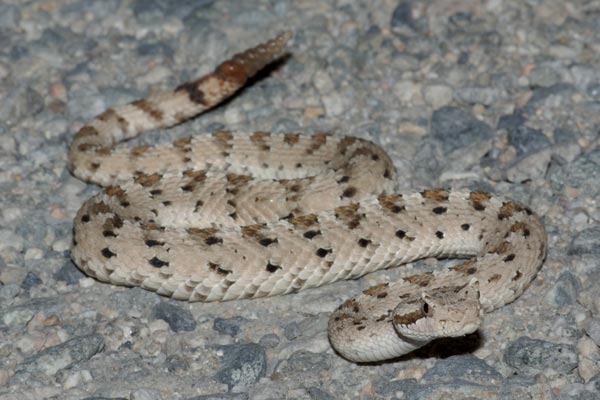
Pinto Basin, Joshua Tree National Park, Riverside County, California—May 19, 2001
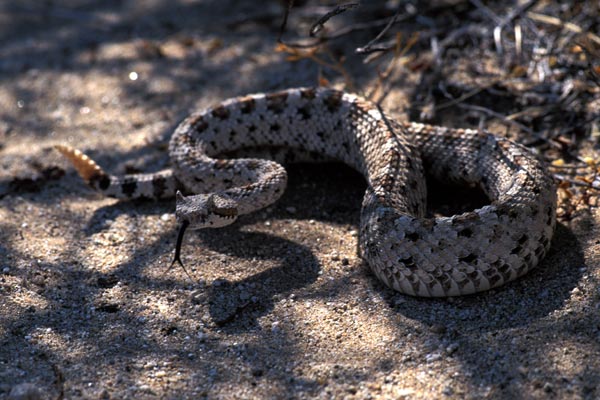
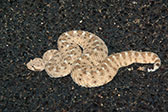
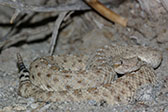
Sidewinders are mostly nocturnal, so we were lucky to encounter this feisty little guy at about 9:30 AM. My friend Don MacCubbin was looking for a slightly shady spot amongst the creosote bushes to change the film in his camera. When he found the nearest shady spot, he discovered at the last moment that this sidewinder had found it first.
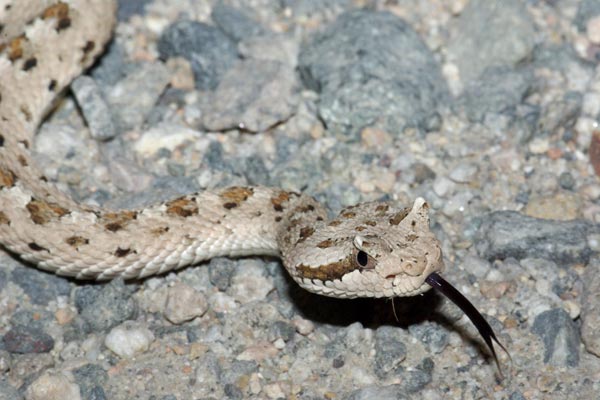
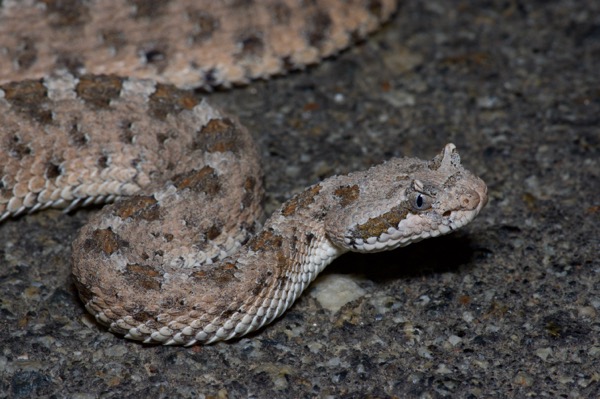
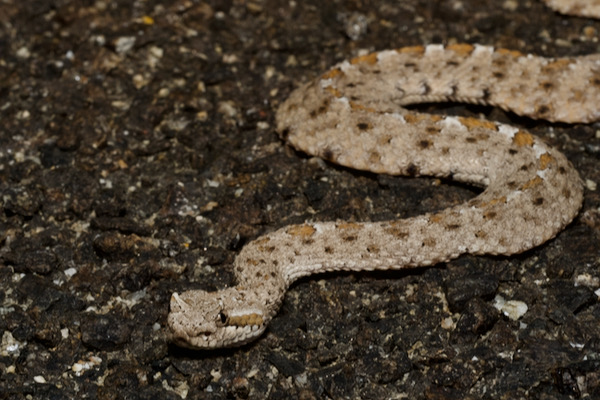
Sidewinders are most notable among rattlesnakes for the "horns" above their eyes and their peculiar sideways slithering. They're among the smallest rattlesnakes, but they still pack a mean wallop, as the cowboys probably had occasion to say. Bartlett & Tennant observe:
Despite the small size of this snake, relatively long fangs, a rather virulent venom, and a readiness to bite if molested, dictate that bites by this rattlesnake should be avoided. Since the venom yield is rather small, envenomation is probably not life-threatening. Envenomation will, however, be sufficiently painful to induce you to use greater future care.
We saw this snake very near the border between the ranges of the Mojave Desert Sidewinder and the Colorado Desert Sidewinder, two subspecies of the same species. The most reliable way to tell them apart is to count the scales around the middle of the body. This would require holding the snake still. Keeping in mind the observation quoted above, I chose to identify this snake an alternate way.
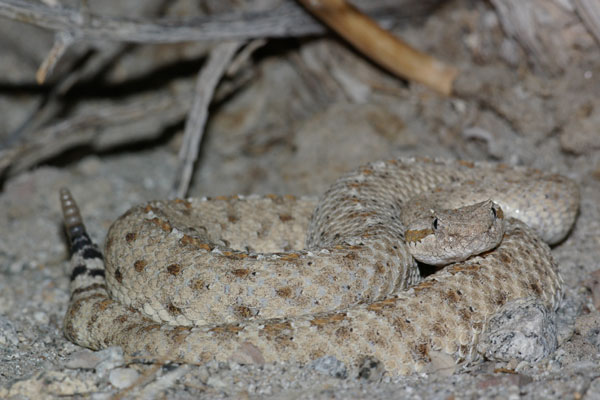
I initially identified it as a Mojave Desert Sidewinder, because the end of the tail right before the rattle is black in Colorado Desert Sidewinders and brown in Mojave Desert Sidewinders, and from my photos, this one's tail end appeared black. My friend Fred Harer pointed out that in Colorado Desert Sidewinders he's seen further south, the black end of the tail is considerably more obvious than in this picture. He later contacted a university herpetologist who concurred that this appeared to be a Mojave Desert Sidewinder, so I've changed the identification of this one.
Stovepipe Wells, Death Valley National Park, Inyo County, California—April 2, 2005
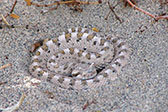
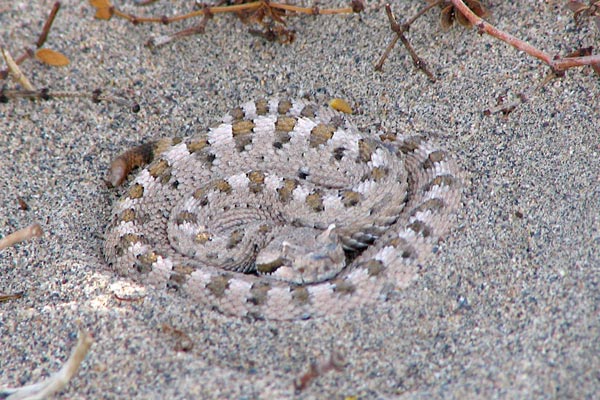
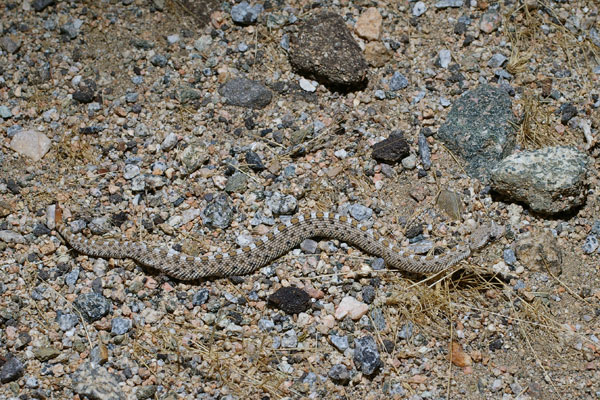
This tiny little baby sidewinder was coiled up in the meager shade of a creosote bush when I noticed its pattern in the early morning. At first glance I thought it was a discarded bracelet.
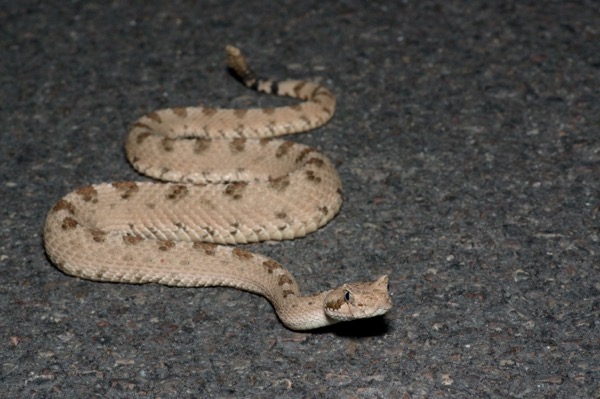
Red Rock Canyon State Park, Kern County, California—September 7, 2006
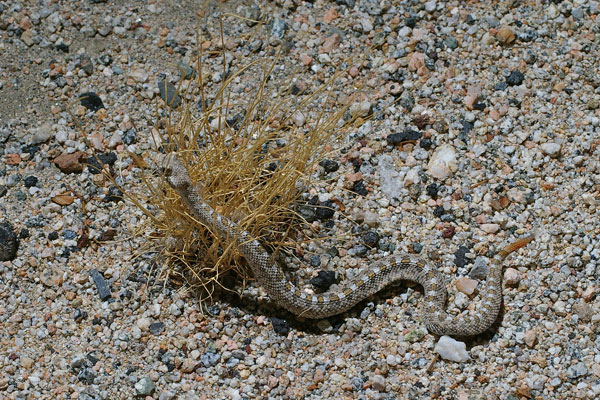
This tiny little guy was creeping along the road just outside of the Red Rock Canyon campground. The road at that point had steep curbs about six inches high, which was clearly higher than the snake would be able to navigate. I let it climb onto a stick and transferred it to the nearby desert. It was moving very slowly, possibly because it was quite a chubby little snakeling.
near Pearsonville, Inyo County, California—September 8, 2006
The next night, my friend Fred Harer, his wife, his mom, and I did some night cruising for herps from Kennedy Meadows down to Pearsonville along Nine Mile Canyon Road. For quite a while it seemed that all we would see were
toads, but as we descended into the warm desert night Fred spotted two little baby sidewinders on the road, both of which he ushered off the road.
Red Rock Canyon State Park, Kern County, California—September 10, 2007
Driving back to the Monterey coast from Las Vegas (via Death Valley and Whitney Portal), we camped for a night at one of our favorite spots in the Mojave desert: Red Rock Canyon State Park. After dark I took my flashlight and walked along the road leading to the campground looking for snakes or other wildlife activity. I had nearly finished my walk with nothing to show for it when I came across this handsome little sidewinder in the campground area.
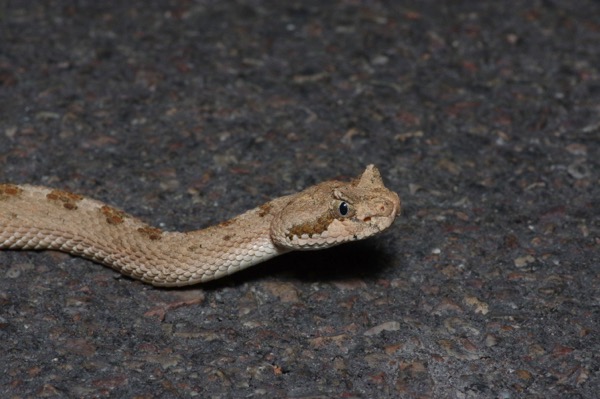
Valley of Fire State Park, Clark County, Nevada—April 26, 2016
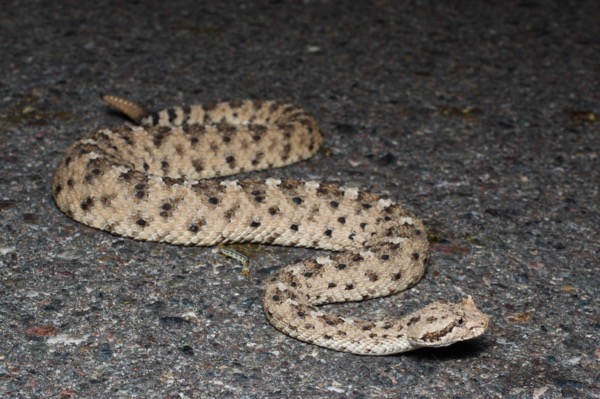
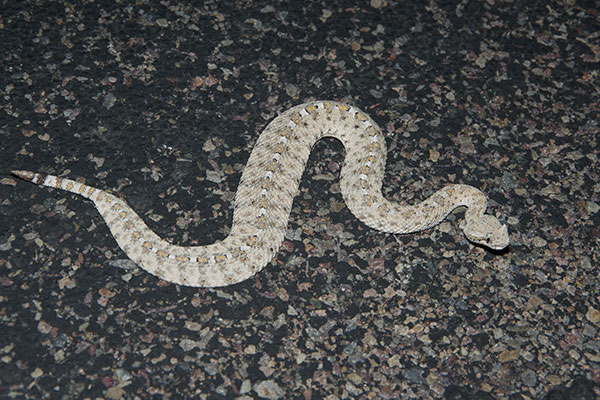
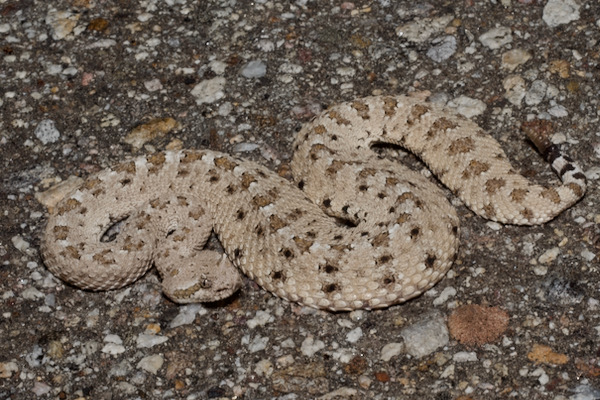
Sidewinders in roads at night often seem to strike the exact same poses.
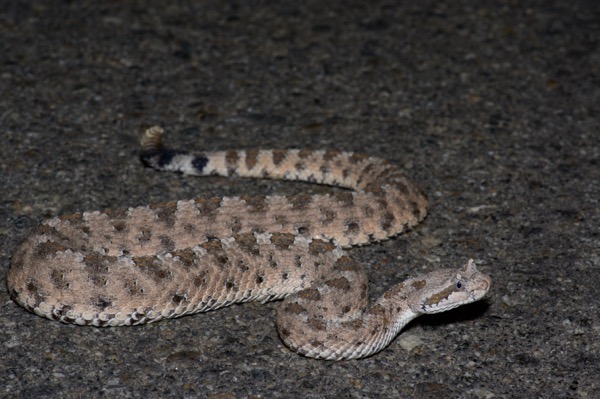
near Cantil, Kern County, California—August 18, 2016
This sidewinder and the previous two show off the variation of appearance even within this one subspecies.
Crotalus cerastes cercobombus
—
Sonoran Sidewinder
Pima County, Arizona—August 2, 2009
After an evening of
radio-tracking rattlers with Roger Repp and some of his friends who were visiting from Chicago, we were heading back for a long-awaited good night's sleep. But on the way, we took a detour to look for sidewinders. Roger practically guaranteed us a sidewinder. First we took an unfortunately uneventful drive down a long, wide, flat dirt road. Next we took an unfortunately exciting rental-car-scraping drive down a long, narrow, bumpy dirt road. Fortunately for me, I was with Roger in his Indestructible Herpmobile, so only the Chicagoans had to worry about the rental-car-scraping aspect of the journey. Unfortunately for everyone, there were still no sidewinders to be seen. So we got back on the paved road and headed homeward once more. Several miles down the road the Chicagoans noted an unusual shape, which turned out to be this oh-so-gravid snake.
Bahía de Kino, Sonora, Mexico—August 18, 2017
This is one of the two sidewinders that Matt Cage, Andrew DuBois, and I found crossing the road at night. Andrew was particularly excited because this was his first sidewinder.
Crotalus cerastes laterorepens
—
Colorado Desert Sidewinder
Anza-Borrego Desert State Park, San Diego County, California—July 2, 2006
This was the first of two sidewinders I came across within half an hour of dusk. This one was out prowling about ten feet away when it saw me. It started rattling while retreating to the protection of a bush, where I got this photo.
I've got to agree with Fred that the black tip of the tail here is much more prominent than on the first sidewinder that I photographed five years earlier.
Borrego Springs, San Diego County, California—April 22, 2009
On this spring trip to Anza-Borrego Desert State Park and environs, sidewinders were the second most common snakes on the road. Where the most common,
Western Shovel-nosed Snakes, were smooth, colorful, and fast-moving, the sidewinders were rough-scaled, beige, and typically motionless. They would typically flatten out on the road, presumably for the warmth. This one was the largest and flattest.
Anza-Borrego Desert State Park, San Diego County, California—April 30, 2009
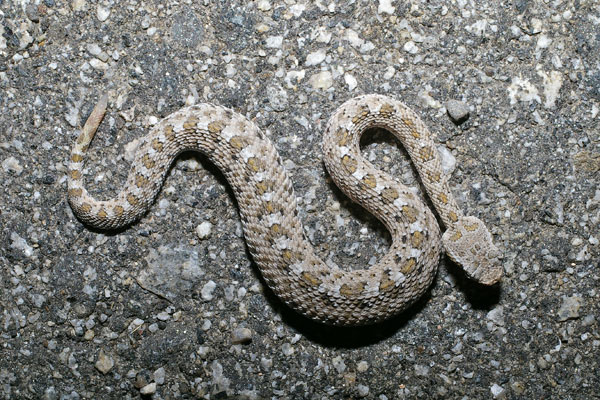
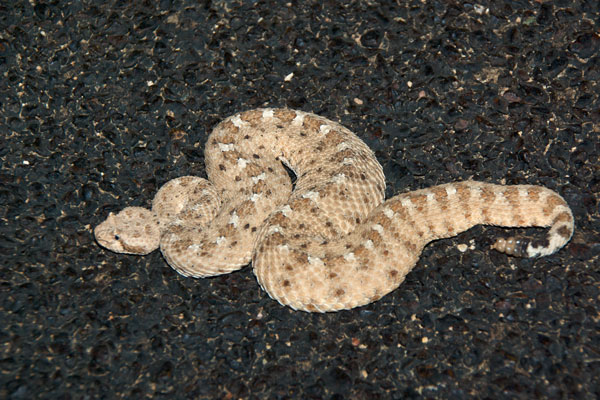
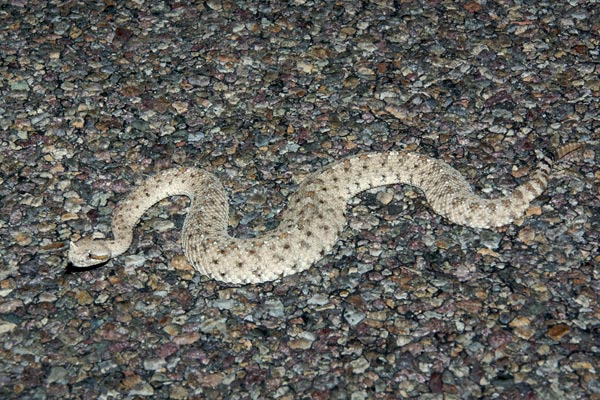
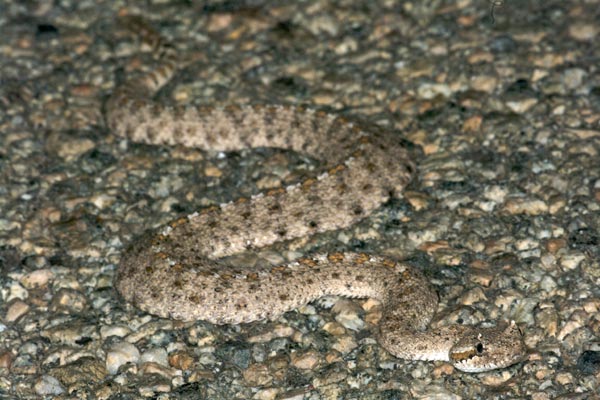
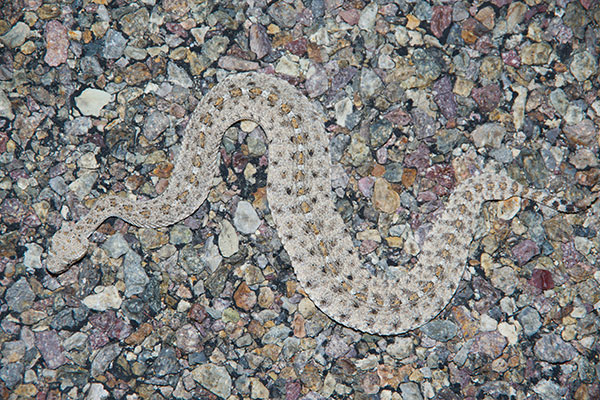
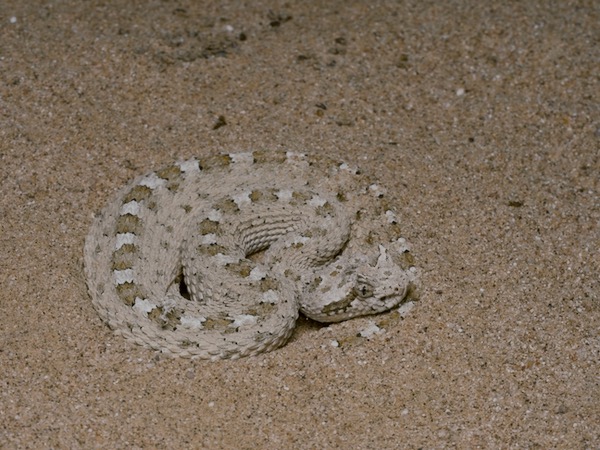
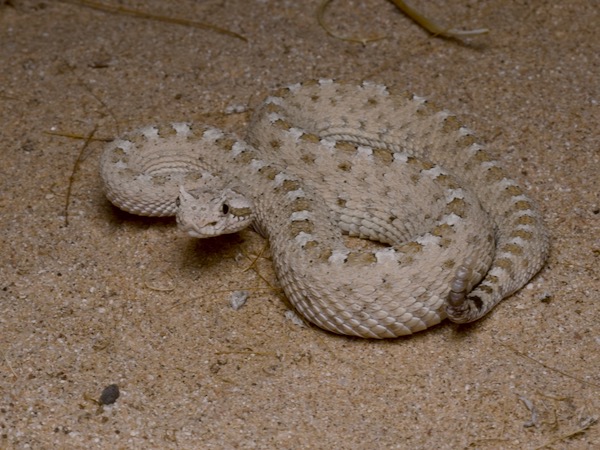
Some of the sidewinders I saw on the roads at night were amazingly good matches for the appearance of the pavement. Here's a youngster that was very hard to rediscover once I had turned my flashlight away from it momentarily.
Borrego Springs, San Diego County, California—June 19, 2012
Against a dark road, a flat heat-absorbing sidewinder is very easy to see.
Borrego Springs, San Diego County, California—June 21, 2012
But against a lighter road, a flat heat-absorbing sidewinder can blend in remarkably well.
Borrego Springs, San Diego County, California—May 25, 2021
I didn't see many snakes on this trip, so each sidewinder was a special treat.
Ocotillo, Imperial County, California—May 27, 2021
So very flat.
Mohawk Dunes, Yuma County, Arizona—August 5, 2022
I spotted this cute li'l fella all curled up at night. Unfortunately my first photo disturbed it and it moved into a defensive position. Sorry I disturbed you!
Printed references:
- Bartlett, R. D., Tennant, A. 2000. Snakes of North America, Western Region
- Behler, J. L., King, F. W. 1979. The Audubon Society Field Guide to North American Reptiles & Amphibians
- Brown, P. R. 1997. A Field Guide to Snakes of California
- Crother, B. I. (ed.) 2017. Scientific and Standard English Names of Amphibians and Reptiles of North America North of Mexico, with Comments Regarding Confidence in Our Understanding, Eighth Edition
- Holycross, A. and Mitchell, J. 2020. Snakes of Arizona
- Lemm, J. M. 2006. Field Guide to Amphibians and Reptiles of the San Diego Region
- Miller, A. H., Stebbins, R. C. 1973. The Lives of Desert Animals in Joshua Tree National Monument
- Smith, H. M., Brodie, E. D. Jr. 1982. Reptiles of North America: A Guide to Field Identification
- Stebbins, R. C. 2003. Peterson Field Guide to Western Reptiles and Amphibians, Third Edition
- Stoops, E. D., Wright, A. 1997. Snakes and other Reptiles of the Southwest, 4th Edition