
Hypsiglena chlorophaea
—
Desert Nightsnake
Also known as:
Desert Night Snake, Nightsnake
Subspecies I've seen:

H. c. chlorophaea
Sonoran Nightsnake
H. c. deserticola
Northern Desert Nightsnake
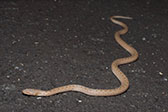
H. c. loreala
Mesa Verde Nightsnake
Hypsiglena chlorophaea chlorophaea
—
Sonoran Nightsnake
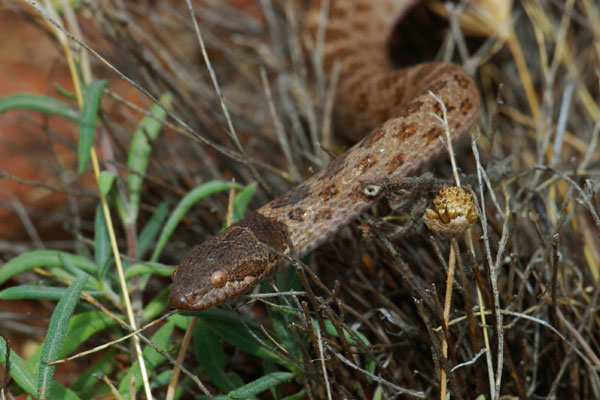
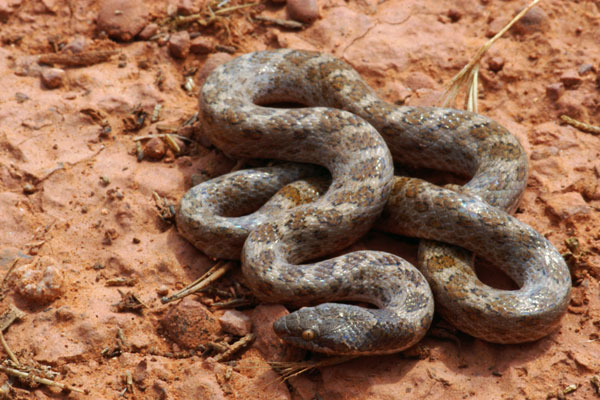
This cute little snake is common throughout much of the western U.S., but I had somehow managed to avoid seeing one for my entire life up to this point. My wife and I were hiking with our friends John and Brenda McCaffrey in the gorgeous red rock country near their Sedona home. I lifted an old dried hunk of yucca and saw a scorpion crouched below. Everyone came over to see the scorpion when John spotted this little snake trying to discreetly glide back into the hunk of yucca I was holding up.
Then while I was trying to coax the snake into sitting still for a photo, Brenda saw a rock move. Only it wasn't a rock, it was a rock lobster! Well, actually it was a short-horned lizard. So it all goes to show that you should be sure to stop and smell the scorpions. Or something like that.
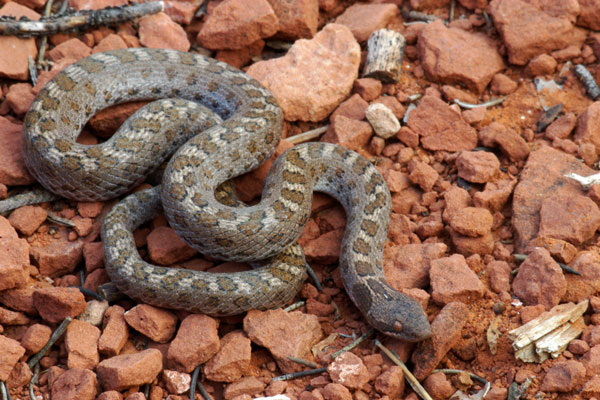
Night snakes, being (surprise!) nocturnal, are not usually seen on the surface by the light of the day. This one was under a flat sandstone rock, and only reluctantly stayed on the surface for a few photos.
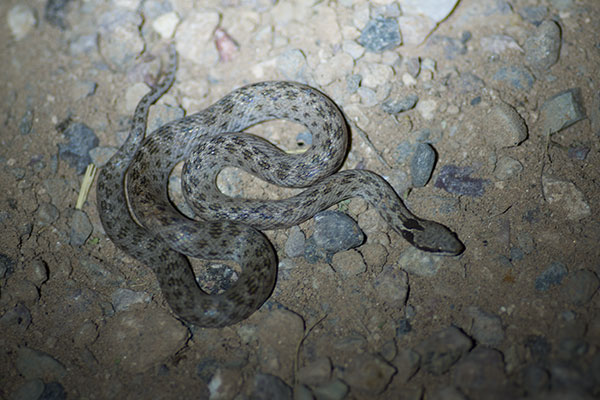
This is possibly the least-exciting nocturnal desert snake, but for some reason I still haven't seen many of them. It's hard to believe that ten years have gone by since I first saw this subspecies, but I think that is indeed the case.
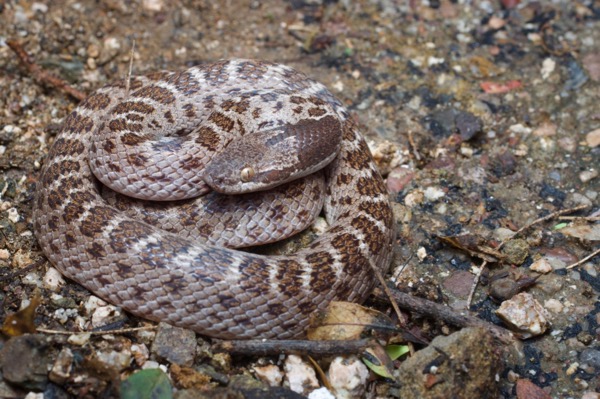
Matt Cage, Andrew DuBois, and I drove for many hours on highway 16 from Hermosillo into the Sierra Madre and back with high hopes for a snake-full evening, but this was the only one we found. (We did also get to photograph a nice lyresnake that Rob and Nicholas Kreutzer had found.) Some nights the snakes are moving, and some nights they aren't, and ya just never know what kind of night you'll get.
Hypsiglena chlorophaea deserticola
—
Northern Desert Nightsnake
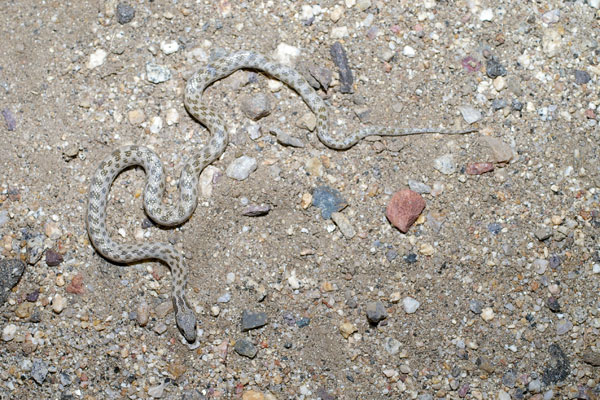
After two nights of road-cruising for snakes in which I had failed to see a single live snake, my luck began to turn when I found a small nightsnake crossing the road. Within an hour or so I also saw two young glossy snakes. Not a very good night for snakes at Anza-Borrego, but a big improvement over none at all.
The taxonomy of this species has been revised numerous times in recent years. I don't think the dust has settled yet, but I'm using the taxonomy described in SSAR names, so I'm calling it H. c. deserticola. Until recently the U.S. nightsnakes were considered part of H. torquata, but that species has now been more narrowly defined such that it exists only in Mexico.
Hypsiglena chlorophaea loreala
—
Mesa Verde Nightsnake
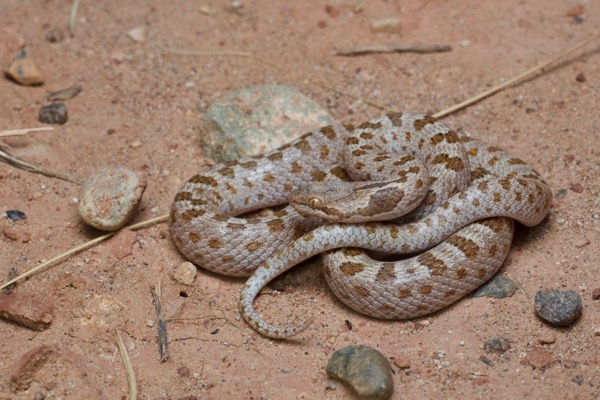
This subspecies is distinguished from the others by the presence of one additional scale between the front of the eye and the nostril. Isn't it obvious?
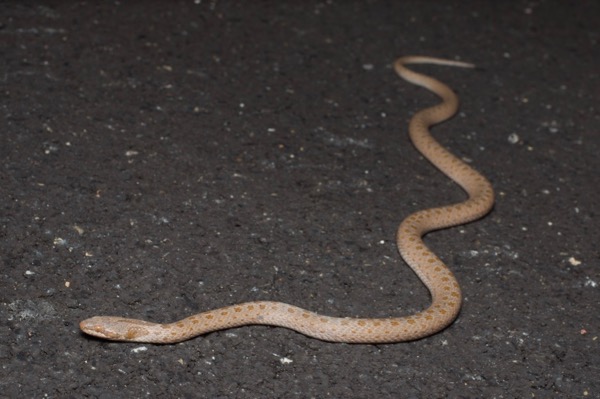
So far this is the only Hypsiglena I've ever seen that held still in a serpentine arrangement. Usually when observed/disturbed they squirm rapidly out of the way, or get all bunched up.
Printed references:
- Behler, J. L., King, F. W. 1979. The Audubon Society Field Guide to North American Reptiles & Amphibians
- Brennan, T. C. and Holycross, A. T. 2006. A Field Guide to Amphibians and Reptiles in Arizona
- Crother, B. I. (ed.) 2017. Scientific and Standard English Names of Amphibians and Reptiles of North America North of Mexico, with Comments Regarding Confidence in Our Understanding, Eighth Edition
- Shedd, J. D. 2005. Amphibians and Reptiles of Bidwell Park
- Smith, H. M., Brodie, E. D. Jr. 1982. Reptiles of North America: A Guide to Field Identification
- Stebbins, R. C. 2003. Peterson Field Guide to Western Reptiles and Amphibians, Third Edition